If a bolted joint is exposed to vibration, shock, or repeated thermal cycling, the nut can back itself off over time — even when it was torqued correctly on day one. A spring washer (also called a split washer, split lock washer, or single-coil washer) is one of the simplest, cheapest ways to fight that. It's a small piece of hardware, but using the wrong one, or fitting it the wrong way round, is one of the more common causes of "mystery" loosening in the field. Here's what it is, how it actually resists loosening, and — just as importantly — when it's the wrong tool for the job.
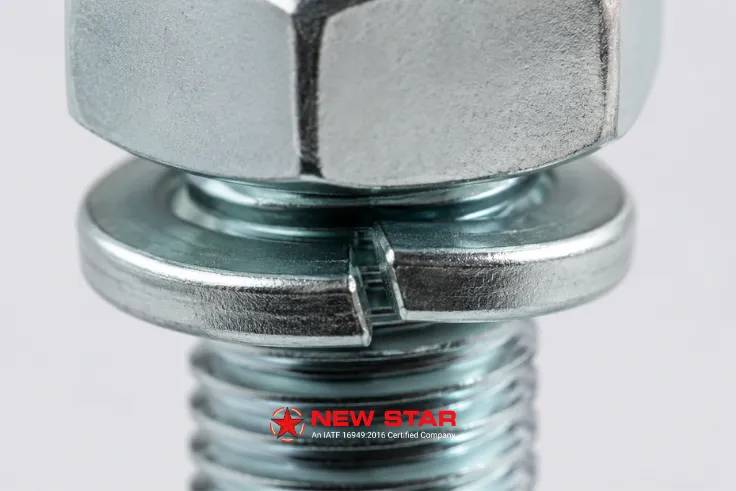
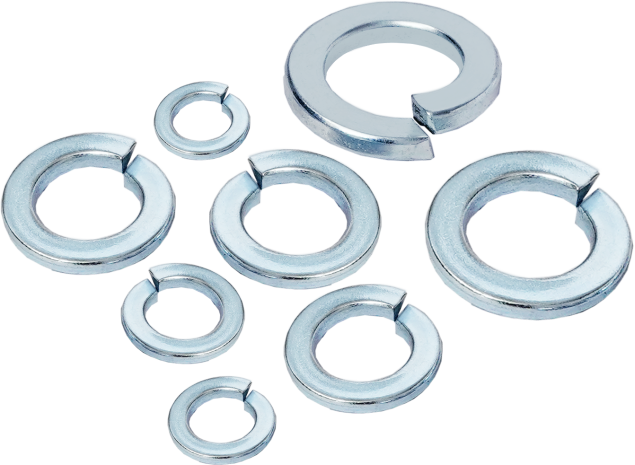
A spring washer is a ring of spring steel with a single cut through it, so the two ends sit slightly out of plane with each other. When you tighten the nut against it, the washer tries to flatten back out. That stored spring force keeps pushing back against the nut face even after the joint has settled, which helps maintain clamp load if the joint loses a little tension through vibration or material creep.
The cut ends also matter mechanically, not just for identification. As the washer compresses, the sharp edges at the split dig slightly into both the nut face and the mating surface. That "bite" resists the nut rotating backward — which is the actual anti-loosening mechanism, separate from the spring tension itself. Lose the bite (by overtightening the joint flat, for example) and you lose most of the locking effect, even though the washer is still technically "there."
You'll see two profile types on spec sheets:
Functionally they do the same job; the difference is mostly about clearance and the standard the application calls for (DIN 127, DIN 128, or similar).
Spring washers go on the nut side, sitting directly against the nut — not under the bolt head, and not sandwiched between two flat washers. If a flat washer is also being used to spread load over a soft or oversized hole, the order from the joint face outward is: mating surface → flat washer → spring washer → nut. The spring washer needs direct metal-to-metal contact with the nut to bite properly; burying it between two flat washers cancels out the locking action entirely, even though it looks correctly assembled.
This is the one worth repeating: if you overtighten the joint, you kill the spring washer's function.
Once the nut is torqued down hard enough to fully flatten the washer, the split ends come back into the same plane and stop biting. At that point you've got a flat, useless disc of spring steel doing nothing but taking up space — no bite, no stored tension, no anti-rotation effect. This is one of the most common reasons spring washers get blamed for "not working" when the real issue was a torque wrench (or an impact driver) going past the point where the washer had any spring left to give.
Rule of thumb: torque to the fastener's rated spec, not until the washer visibly flattens. If you can see the split has closed completely, it's over-torqued.
Good fit:
Not a good fit:
| Feature | Spring (Split) Washer | Flat Washer | Nord-Lock / Wedge-Lock Pair |
|---|---|---|---|
| Primary Job | Resist nut rotation under vibration | Spread load, protect surface | Resist nut rotation under vibration |
| Mechanism | Spring tension + biting edge | None (passive load spreading) | Cam/wedge action between two washers |
| Reusable? | Limited — bite dulls with reuse | Yes | Yes, generally more reuse-tolerant |
| Best For | Light-to-moderate vibration | General assembly, oversized holes | High-vibration, safety-critical joints |
| Cost | Low | Low | Higher |
Spring washers are typically spring steel, zinc-plated for general use, or stainless steel (A2/A4) where corrosion resistance matters — outdoor fixings, marine environments, or anywhere dissimilar metals could otherwise cause galvanic corrosion. If the rest of the fastener stack is stainless, match the washer grade; a plated steel washer against a stainless bolt in a damp environment will corrode faster than either would alone.
New Star Industries manufactures spring washers to these standards alongside our wider fastener range, so the washer grade can be matched to the bolt and nut grade already specified on your drawing.
With 60+ years of manufacturing experience, New Star Industries specializes in:
The company operates a state-of-the-art facility with CNC machines, forging presses, heat treatment furnaces, and quality testing labs.
Do spring washers actually work?
Yes, for light-to-moderate vibration, provided they're correctly seated against the nut and not over-torqued flat. For high-vibration or safety-critical joints, a wedge-locking washer or prevailing-torque nut is the more reliable choice.
Can you reuse a spring washer?
Not ideally. The biting edges dull after the first compression cycle, so a reused washer offers less locking effect than a new one — fine for a low-stakes joint, not recommended for anything vibration-critical.
Square section or rectangular section — does it matter which I buy?
Mostly it comes down to the standard your drawing or application calls for (DIN 127A/B vs DIN 128, for example) and clearance in the joint. Neither is inherently "better" — check your spec before substituting one for the other.
What's the difference between a spring washer and a Belleville washer?
A spring washer is a split ring designed mainly to resist nut rotation. A Belleville (disc spring) washer is a solid, conical disc designed to provide a controlled, calculable spring load — used more in applications needing precise preload than anti-vibration locking.
A spring washer is a small, inexpensive part, but getting it wrong — the wrong stack order, the wrong torque, the wrong application — quietly undermines the joint it's meant to protect. For applications with genuine safety or high-vibration demands, it's worth stepping up to a wedge-locking washer or prevailing-torque nut instead.
At New Star Industries, we manufacture spring, flat, and structural washers to match the fastener grade and application you're specifying — reach out to our team if you'd like help selecting the right locking method for your joint.
Vikram Bhamra – CEO, New Star Industries
Vikram Bhamra is the CEO of New Star Industries, a third-generation manufacturing company specializing in high-performance fasteners for automotive, infrastructure, and heavy engineering applications. After graduating in Business Management from Canada in 2010, he returned to India in 2011 to lead and modernize the family enterprise. With 14+ years of hands-on experience, he has driven advancements in cold forging, zinc flake coating, and precision heat treatment. In 2024, he founded New Star AutoComp, expanding cold forged fasteners into automotive OEMs, railway bridges, PEB, and heavy engineering sectors with globally compliant fastening solutions.