What Is a Fastener?
A fastener is a hardware device that mechanically joins two or more objects. Unlike welding or adhesives, most fasteners create non-permanent joints — meaning the connection can be disassembled without damaging the mating components.
Fasteners are used across every industry, from tiny screws in electronics to massive anchor bolts in concrete foundations. The wide variety of types exists because every application has unique demands around load, vibration, temperature, corrosion exposure, and installation access.
How Are Industrial Fasteners Classified?
Industrial fasteners fall into two broad categories:
Threaded Fasteners — Bolts, screws, nuts, and studs. They use helical threads to develop clamping force and dominate industrial use because they are removable, re-torqueable, and can be loaded to precise preloads.
Non-Threaded Fasteners — Rivets, pins, retaining rings, and clips. They join materials through deformation, interference fit, or spring force rather than threads.
Within these categories, fasteners are further defined by head type, drive type, material grade, and the standard they conform to — IS, DIN, ASTM, ISO, or EN.
Bolts
Bolts are externally threaded fasteners that pass through unthreaded clearance holes and are secured by a nut on the opposite side. They are the primary fastening solution in structural steel, heavy machinery, pressure vessel flanges, pipeline connections, and automotive assemblies.
Hex Head Bolts
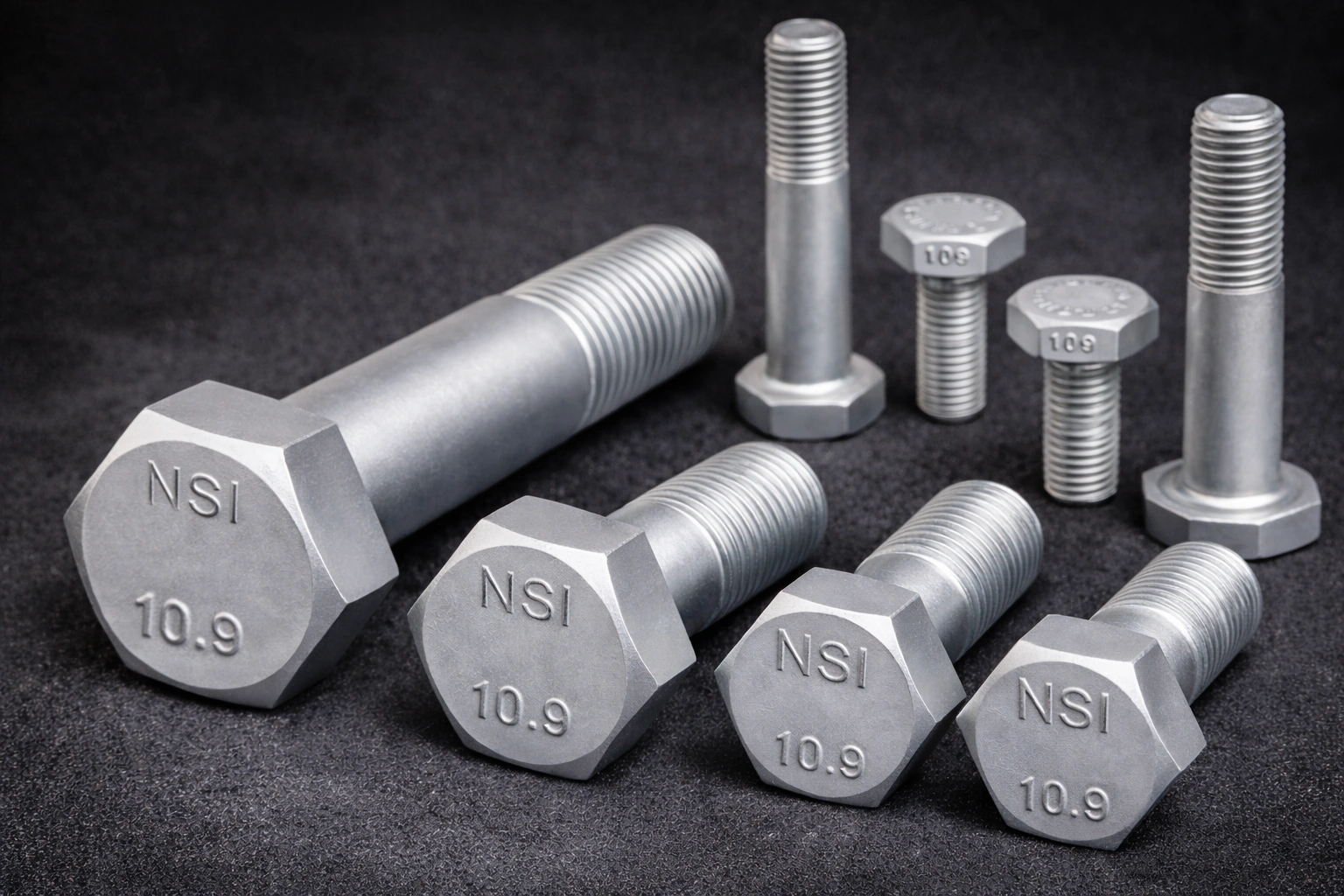
The most widely used bolt in industry. The six-sided head provides reliable wrench engagement. Used in structural steel, machinery frames, bridges, and general fabrication across every sector.
Carriage Bolts
A domed head and square neck prevent rotation in the mating material, enabling one-sided installation. Common in timber framing, wood-to-metal connections, and railway applications.
Flange Bolts
An integrated flange acts as a built-in washer, distributing load over a larger bearing area. Standard in automotive assemblies, pipe flanges, and vibration-prone mechanical joints.
Heavy Hex Structural Bolts
Manufactured to ASTM A325 / A490 for high-strength structural steel connections. Used in bridges, buildings, industrial platforms, and transmission towers.
Foundation Bolts (Anchor Bolts)
Embedded in concrete to anchor structural columns, machinery bases, and equipment. Available in L-bolt, J-bolt, and straight configurations. Placement must be correct before concrete cures.
Eye Bolts
A looped head provides an attachment point for lifting slings and rigging hardware. Rated lifting eye bolts are a standard component in material handling and construction.
U-Bolts
U-shaped with threads on both open ends. Used to clamp pipes, tubes, and round profiles to a surface. Common in piping supports, automotive systems, and agricultural equipment.
Square Head Bolts
The four-sided head resists rounding under high torque and provides more wrenching area. Widely used in heavy rail infrastructure, agricultural machinery, and older industrial equipment.
Screws
Screws either thread into a pre-tapped hole or cut their own threads as they are driven. Used where a nut on the reverse side is inaccessible, or where the assembly loads are lighter than a full bolt-and-nut system requires.
Self-Tapping Screws
Cut their own threads on installation — no pre-tapping needed. Widely used in sheet metal fabrication, HVAC ducting, automotive body panels, and electrical enclosures.
Machine Screws
Fully threaded, installed into pre-tapped holes or with a nut. Available in multiple head types (pan, flat, oval) and drive types (Phillips, slotted, hex socket). Standard in precision machinery, electronics, instrumentation, and equipment assembly.
Socket Head Cap Screws
A cylindrical head with a recessed internal hex (Allen) drive allows installation in confined spaces where a conventional wrench cannot reach. The head recesses flush in a counterbored hole. Essential in machine tools, hydraulic manifolds, and precision assemblies.
Countersunk Socket Head Screws
A flat conical head sits completely flush with the material surface when installed in a countersunk hole. Used in aerospace panels, machine guards, and electronic enclosures where a protruding head is unacceptable.
Set Screws (Grub Screws)
Headless screws installed entirely below the surface. Used to lock gears, pulleys, and collars onto shafts by bearing against the shaft. Standard in power transmission components across all manufacturing sectors.
Nuts
Nuts are internally threaded fasteners that mate with bolts or studs to clamp components together. Selection depends on load, vibration, access constraints, and whether positive locking is required.
Hex Nuts
The universal standard nut, paired with hex bolts across all industries in every thread size and grade.
Flange Nuts
An integrated flange combines the function of nut and washer, distributing clamping load over a wider area. Common in automotive and vibration-prone applications.
Lock Nuts & Nylock Nuts
Engineered to resist self-loosening under vibration through mechanical interference or a nylon insert collar. Essential in any dynamically loaded joint. Nylock nuts are cost-effective for light-to-medium applications where temperatures stay below approximately 100°C.
Castle Nuts (Slotted Nuts)
Slots across the top face accept a cotter pin through a cross-drilled hole in the bolt shank, providing positive mechanical locking. Standard in wheel bearings, steering linkages, and safety-critical rotating joints.
Heavy Hex Nuts
Larger and thicker than standard hex nuts, providing greater thread engagement and bearing area for structural steel connections. Manufactured to ASTM A563 or equivalent standards.
Dome Nuts (Acorn Nuts)
A closed, domed end covers and protects exposed bolt threads. Used in automotive, architectural, and machinery applications where thread protection and appearance both matter.
Wing Nuts
Hand-tightened without tools. Used on access covers, inspection panels, and temporary assemblies requiring frequent removal and reinstallation.
Weld Nuts
Permanently welded to a panel or structure to create a fixed threaded insert. Common in automotive body manufacturing and sheet metal enclosures where nut access from the reverse side is impossible.
Washers
Washers distribute clamping load, protect mating surfaces, prevent loosening, and bridge oversized clearance holes. A joint missing the correct washer can fail simply through bearing stress on the mating surface.
Plain (Flat) Washers
Distribute load under the bolt head or nut. Used in virtually every bolted assembly across all industries and materials.
Spring Washers
Provide axial spring force that maintains bolt tension as the joint settles under vibration and thermal cycling. The split-ring design also resists rotational loosening. Common in machinery and electrical equipment.
Structural Washers
Heavy, hardened washers for structural steel connections, manufactured to tight thickness and hardness tolerances to ensure consistent load distribution.
Direct Tension Indicator (DTI) Washers
Raised protrusions on the bearing face compress flat when the bolt reaches the specified preload, giving site inspectors a visual confirmation of correct bolt tension in structural connections.
Belleville Washers (Disc Springs)
Conical spring washers that maintain a controlled clamping force through thermal expansion and joint relaxation. Used in high-temperature bolted joints and precision assemblies requiring consistent clamp load.
Studs
Studs are headless, externally threaded fasteners anchored at one end into a tapped hole, with a nut applied at the other end. Preferred where a mating component must be removed repeatedly for maintenance while the stud remains permanently installed.
Double End Threaded Studs
Threaded at both ends with a plain shank in the middle. One end is permanently installed into a tapped hole; the other end receives a nut. Used in engine cylinder heads, pump flanges, compressor housings, and pressure vessel covers.
B7 Studs — ASTM A193 Grade B7
Manufactured from chromium-molybdenum alloy steel (AISI 4140/4142), maintaining high tensile strength at temperatures up to 450°C. The industry standard for high-pressure, high-temperature flanged connections in oil and gas, petrochemical, refinery, and power generation. Supplied with Grade 2H heavy hex nuts and full material certification.
Rivets
Rivets are permanent fasteners that form a fixed joint by deforming their tail after installation. Ideal where vibration would eventually loosen any threaded fastener, or where tamper resistance is required.
Solid Rivets
The strongest rivet type. The tail is deformed using a rivet gun and bucking bar. Used in structural steel, bridge construction, boilermaking, and historically in shipbuilding and aircraft structures.
Blind Rivets (Pop Rivets)
Installed from one side only, ideal for enclosed or inaccessible reverse faces. A mandrel is pulled through the tubular body, expanding it to form a blind head. Standard in automotive panels, sheet metal enclosures, and electronics assemblies.
Round Head Rivets
A traditional solid rivet with a dome-shaped head. Still used in boilermaking, structural steel fabrication, and decorative metalwork where a rounded external head is preferred.
Pins
Pins are non-threaded fasteners used for alignment, pivoting, or load transfer between components. Simple, reliable, and require no torque to install — an advantage in high-cycle assembly operations.
Dowel Pins
Precision-ground cylindrical pins pressed into aligned holes to accurately locate two components relative to each other. Standard in tooling, mould and die sets, and precision machinery sub-assemblies.
Clevis Pins
Smooth shank with a cross-drilled hole at one end for a cotter pin. Used in linkages and pivot joints in agricultural equipment, construction machinery, and hydraulic cylinder clevises.
Cotter Pins (Split Pins)
Soft metal pin split along its length, inserted through a cross-drilled hole and bent outward to lock castle nuts and clevis pins. A simple and reliable locking device used throughout automotive and industrial machinery.
Spring Pins (Roll Pins)
Slotted or coiled pins that compress on insertion and grip the hole by interference fit. Cost-effective for locating and retaining components on shafts and levers in light machinery and equipment.
Anchors
Anchors secure objects to concrete, masonry, brick, or hollow sections by expanding against, bonding with, or interlocking with the base material to resist pull-out and shear loads.
Expansion Anchors (Mechanical Anchors)
Expand inside a drilled hole as the bolt is tightened, gripping the hole walls by mechanical wedging. Used to fix machinery, structural steel, mezzanine structures, and equipment bases to concrete floors and walls.
Chemical Anchors (Resin Anchors)
Two-component resin bonds a threaded rod into a cleaned, drilled hole. Provides high load capacity and superior performance near edges and in cracked concrete. Standard for structural connections to concrete in construction and infrastructure.
Screw Anchors (Concrete Screws)
Hardened screws that cut directly into concrete without a separate expansion element. Fast to install and removable. Used for lighter fixings — conduit brackets, framing elements — directly into concrete and masonry.
Retaining Rings & Clips
Retaining rings snap into machined grooves on shafts or inside bores, providing a positive axial stop for bearings, gears, and other components — with no tightening required.
Circlips (Snap Rings)
Sprung steel rings that snap into a groove on a shaft (external) or inside a bore (internal). Standard in gearboxes, automotive transmissions, hydraulic cylinders, and shaft-and-bearing assemblies.
E-Clips
Lighter retaining rings pushed onto a shaft groove from the side without special pliers. Common in light machinery and appliances where a simple, quick-install axial stop is needed.
Grease & Hydraulic Fittings
Grease Nipples (Zerk Fittings)
Small spring-loaded fittings threaded into bearing housings and pivot joints. A grease gun forces lubricant in under pressure; a check valve prevents backflow and contamination. Found on virtually every piece of heavy equipment, commercial vehicle, and agricultural machinery. Critical for preventing premature bearing wear.
Hydraulic Fittings
Connect hoses, pipes, and tubing to valves, cylinders, and manifolds under pressures often exceeding 300 bar. Thread form, pressure rating, and sealing method (BSP, NPT, JIC, or metric parallel) must be correctly matched to the hydraulic circuit.
Fastener Materials
The material of a fastener determines its strength, corrosion resistance, temperature range, and cost. Specifying the wrong material for an environment is as serious an error as specifying the wrong grade.
| Material | Key Properties | Typical Applications |
|---|---|---|
| Carbon Steel | High strength, low cost | General industrial, non-corrosive environments |
| Stainless Steel 304 / 316 | Excellent corrosion resistance | Coastal, marine, food processing, chemical |
| Alloy Steel (B7) | High strength at elevated temperature | Oil, gas, petrochemical, power generation |
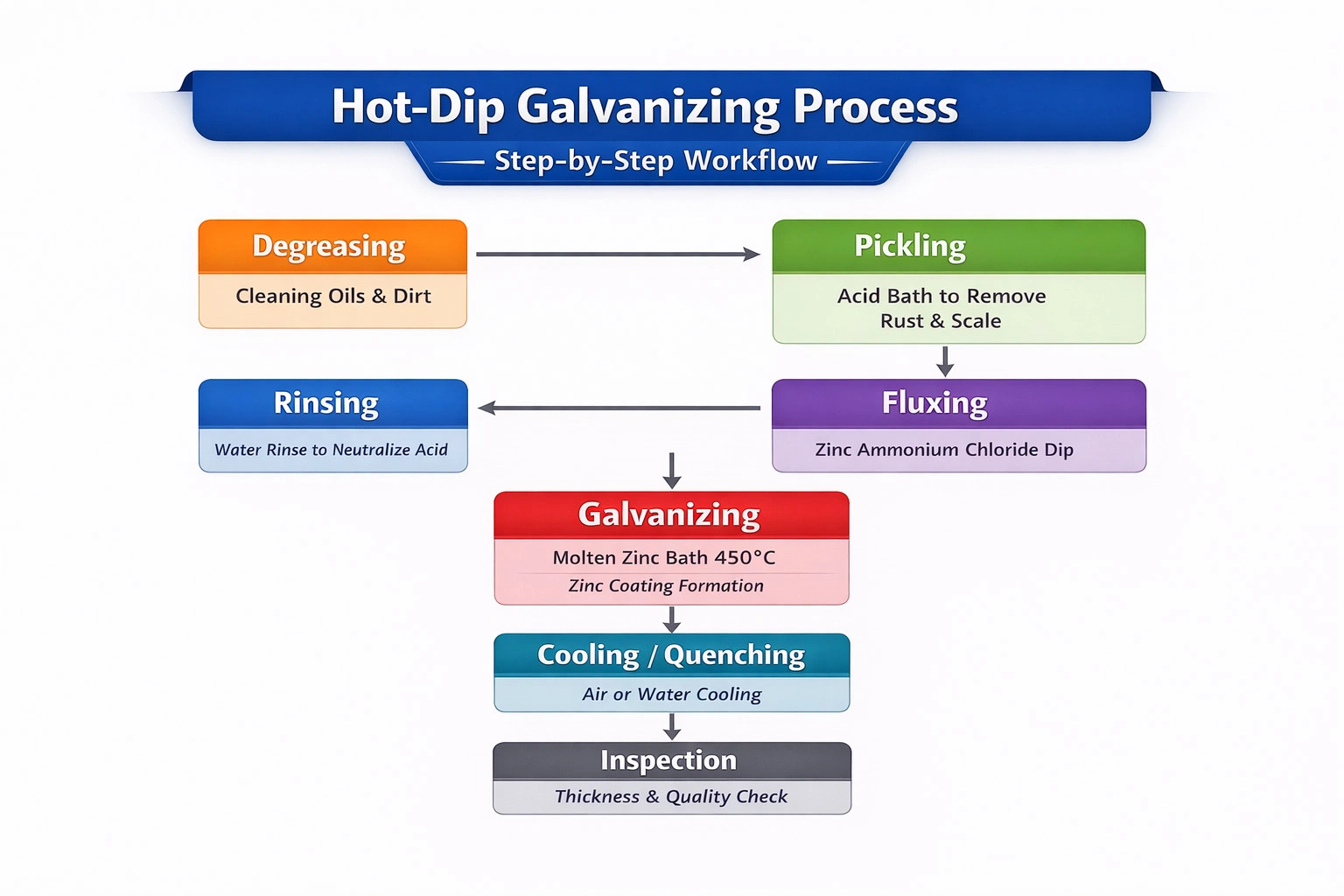
| Hot-Dip Galvanized | Thick zinc coating, weather resistant | Outdoor structural, infrastructure, utilities |
| Brass / Copper Alloys | Corrosion resistant, electrically conductive | Electrical equipment, marine, plumbing |
| Titanium | High strength-to-weight, corrosion resistant | Aerospace, medical, weight-critical applications |
Fastener Grades & Standards
Fasteners are manufactured to mechanical property standards that define minimum tensile strength, yield strength, proof load, and hardness. Using an incorrect grade in a structural or pressure application is one of the most dangerous specification errors in engineering.
Common metric bolt grades: 4.6 · 4.8 · 5.6 · 6.8 · 8.8 · 10.9 · 12.9. The first digit × 100 gives approximate tensile strength in MPa; both digits multiplied ÷ 10 gives approximate yield strength.
| Standard | Scope |
|---|---|
| IS (BIS) | Bureau of Indian Standards — applicable for the Indian market |
| ASTM A325 / A490 | High-strength structural bolts for steel construction |
| ASTM A193 / A194 | Alloy steel bolting for high-temperature pressure service |
| DIN | German standard, widely adopted internationally |
| ISO | International harmonized fastener dimensions and grades |
| EN 14399 | European structural bolt assemblies for preloaded connections |
Always insist on material test certificates from your supplier confirming the supplied grade matches the specification. Counterfeit and substandard fasteners are a documented global problem — the consequences in critical applications can be catastrophic.
How to Select the Right Fastener
Choosing the correct fastener requires answering a clear set of questions before specifying:
-
What loads will the fastener carry? Tensile (axial pull), shear (lateral force), or both? Load magnitude and direction determine the required grade and size.
-
Is the joint permanent or removable? Removable joints need threaded fasteners. Permanent joints can use rivets or weld nuts for a tamper-resistant, lower-part-count solution.
-
What is the operating environment? Moisture, salt, chemicals, high temperature, UV, and vibration all drive material and coating selection.
-
What are the installation access conditions? One-sided access requires blind rivets or self-tapping screws. Tight clearances need socket head cap screws.
-
What standard applies to the project? Structural and pressure applications require ASTM, IS, DIN, or EN-certified fasteners with full traceability and third-party certification.
Industries That Rely on Precision Fasteners
- Construction & Infrastructure Structural bolt assemblies, foundation bolts, and chemical anchors hold together every bridge, building, and civil infrastructure project.
- Automotive & Commercial Vehicles From engine internals to chassis and body panels, vehicles use thousands of fasteners — grade and application-specific selection directly affects safety.
- Oil, Gas & Petrochemical ASTM A193 B7 studs with 2H nuts are the standard for high-pressure, high-temperature flanged connections throughout the sector.
- Power Generation Turbines, boilers, and pressure vessels demand the same high-grade bolting as oil and gas, with zero tolerance for in-service failure.
- Railways & Heavy Equipment High-strength structural bolts, carriage bolts, clevis pins, and castle nuts are found throughout rail infrastructure and construction machinery.
- Manufacturing & Industrial Automation Socket head cap screws, dowel pins, set screws, and circlips are the standard fasteners in machine tools, hydraulic systems, and automated lines.
Conclusion
Every industrial structure, machine, and assembly depends on fasteners being correctly specified — not just the right type and size, but the right grade, material, coating, and standard. A fastener that looks identical to the correct one but carries the wrong grade or is made from the wrong material can cause a joint failure that costs far more than the component itself.
Understanding the full range of fastener types, their mechanical purpose, and their appropriate applications is the foundation of safe, reliable engineering. Whether you are sourcing for a steel structure, a high-pressure pipeline, a vehicle assembly, or a precision machine, the investment in correct specification always pays back many times over in service life and safety.
Need Fasteners for Your Project?
At New Star Industries, we manufacture hex bolts, structural bolt assemblies, flange bolts, foundation bolts, nuts, lock nuts, washers, B7 studs, double end threaded studs, and grease nipples — to Indian and international standards, with full material certification and traceability.
Contact Our Team