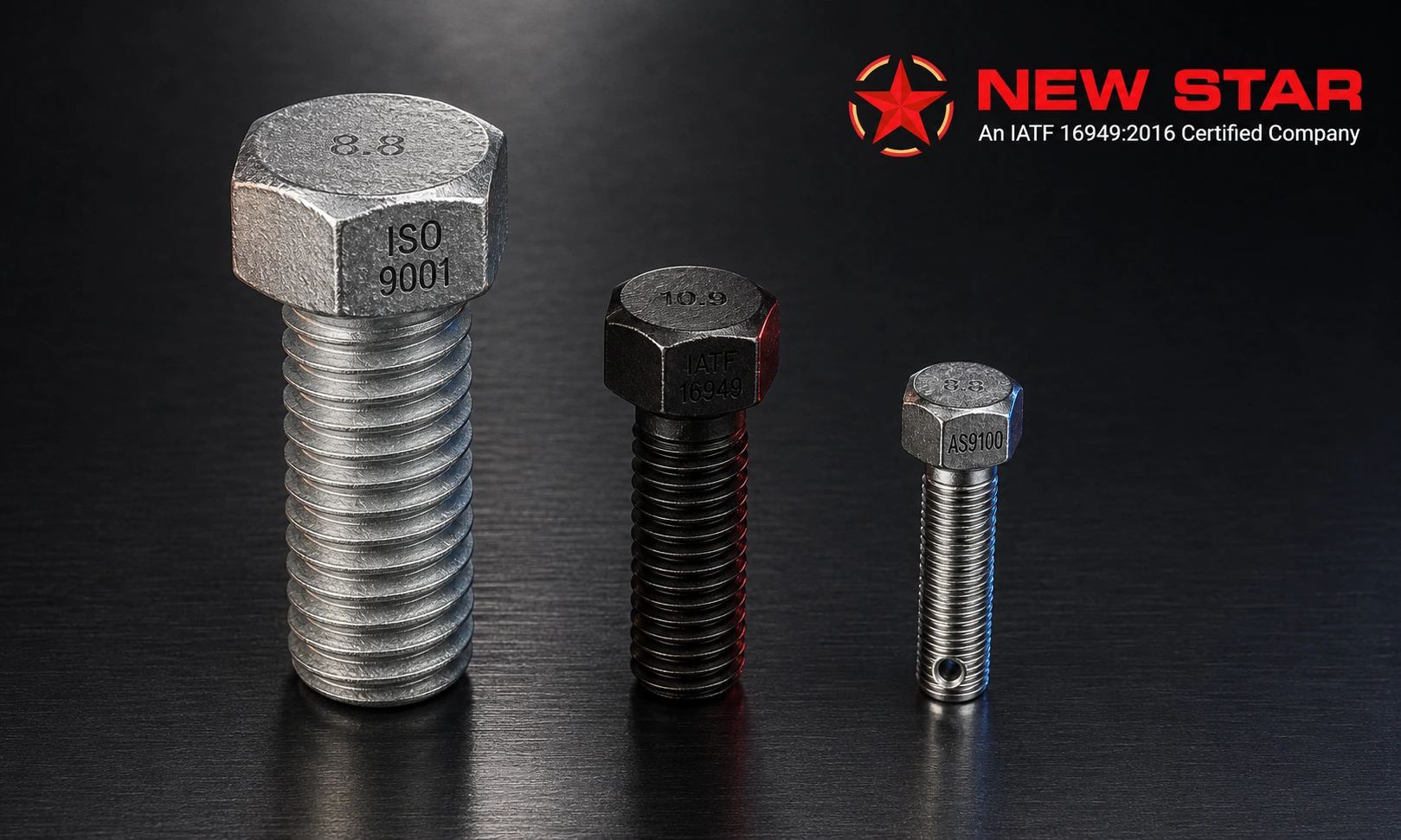
Why Fastener Buyers Should Care About Certifications
A bolt that looks correct on a datasheet can still be the wrong part for a job if it was manufactured under a quality system that does not match the industry it is going into. Certifications are not paperwork for the sake of paperwork — they describe the discipline, documentation, and traceability built into the way a fastener is made.
For a procurement team sourcing structural bolts, automotive fasteners, or aerospace hardware, the certification on a supplier's letterhead is often the fastest way to judge whether that supplier's processes match the risk level of the application. This is exactly why ISO 9001, AS9100, and IATF 16949 keep showing up in supplier qualification checklists, RFQs, and audit forms.
What Is ISO 9001?
ISO 9001 is the world's most widely adopted quality management system (QMS) standard, published by the International Organization for Standardization. It sets out requirements for how a company plans, controls, and improves its processes so that the end product consistently meets customer and regulatory expectations.
The standard is deliberately generic. A textile mill, a software company, and a fastener manufacturer can all be certified to ISO 9001 because it focuses on management principles — customer focus, process control, continual improvement, leadership commitment — rather than the technical detail of any single product.
For a fastener manufacturer, ISO 9001 certification signals that the basics are in place: incoming material checks, documented work instructions, calibrated measuring equipment, non-conformance handling, and a structured approach to fixing recurring problems. It is the entry point most credible suppliers are expected to clear before a buyer even considers a sector-specific certificate. In structural steel construction, for example, ISO 9001 is the standard quality baseline expected from suppliers of High Strength Friction Grip (HSFG) bolts — including EN 14399 structural bolt assemblies used in preloaded connections across bridges, industrial platforms, and steel-framed buildings.
What Is AS9100?
AS9100 is the quality management standard written for the aerospace, space, and defence supply chain. It was developed by the International Aerospace Quality Group with input from major aircraft manufacturers, and it is built directly on top of ISO 9001 — every ISO 9001 clause is retained, with aerospace-specific requirements layered on.
The additional requirements address the things that matter most when a part failure can affect flight safety: configuration management so every component revision is tracked, product safety review through the design and manufacturing lifecycle, and a formal counterfeit-parts prevention process. AS9100 also pushes risk management much further than ISO 9001 alone, requiring suppliers to identify and mitigate risk at every stage rather than reacting after a defect appears.
For fasteners destined for aircraft structures, engines, or defence equipment, AS9100 certification is generally treated as a non-negotiable gatekeeper. Aerospace primes will rarely place an order with an uncertified supplier for flight-critical hardware.
What Is IATF 16949?
IATF 16949 is the global automotive quality standard, developed by the International Automotive Task Force, a body formed by major car manufacturers and their national trade associations. Like AS9100, it is layered on the ISO 9001 structure rather than replacing it — a company must hold ISO 9001 before it can add IATF 16949 on top.
The automotive additions are built around what the industry calls core tools: Advanced Product Quality Planning for new parts, the Production Part Approval Process before a part is approved for mass production, Failure Mode and Effects Analysis to anticipate what could go wrong, Statistical Process Control to monitor production in real time, and Measurement Systems Analysis to confirm gauges are reliable. There is also a strong emphasis on reducing variation and waste across a high-volume, cost-sensitive supply chain.
For fastener manufacturers supplying engine components, chassis hardware, or body assembly parts, IATF 16949 is usually a hard requirement from OEMs and Tier 1 suppliers before any commercial discussion begins.
Side-by-Side Comparison
| Aspect | ISO 9001 | AS9100 | IATF 16949 |
|---|---|---|---|
| Industry Scope | Any industry, any size | Aerospace, space, defence | Automotive production and service parts |
| Governing Body | International Organization for Standardization | International Aerospace Quality Group | International Automotive Task Force |
| Built On | Stand-alone standard | Full ISO 9001 structure plus aerospace clauses | Full ISO 9001 structure plus automotive clauses |
| Key Focus | Customer satisfaction, process consistency | Safety, configuration control, counterfeit prevention | Defect prevention, variation reduction, core tools |
| Distinct Requirements | None — this is the baseline | Risk management, traceability, product safety review | APQP, PPAP, FMEA, SPC, MSA, control plans |
| Certifying Bodies | Any accredited certification body | Aerospace-accredited auditors only | IATF-recognised certification bodies only |
| Typical Buyer | General industrial and structural customers | Aircraft OEMs, defence contractors | Vehicle OEMs, Tier 1 automotive suppliers |
Key Differences Explained
Scope of Application
ISO 9001 applies to an entire organisation regardless of what it produces. AS9100 and IATF 16949 apply only to the sites and processes that actually manufacture parts for their respective industries — a fastener plant could hold IATF 16949 for its automotive production line while the rest of the business simply runs under ISO 9001.
Documentation and Traceability
ISO 9001 expects reasonable record-keeping. AS9100 raises that bar considerably, requiring full configuration traceability so that any part can be traced back to its exact specification, revision, and manufacturing batch. IATF 16949 requires similar batch-level traceability but ties it closely to PPAP documentation, which records exactly how a part was approved for production.
Risk Versus Cost Philosophy
Aerospace standards lean heavily toward eliminating risk regardless of cost, because the consequence of failure is severe. Automotive standards balance quality against the realities of high-volume, cost-sensitive manufacturing, focusing on catching variation early rather than treating every part as a one-off critical component.
Calibration and Measurement
ISO 9001 only requires calibration of equipment that meaningfully affects product quality. IATF 16949 is stricter, requiring documented calibration and verification activity with records confirming the equipment met specification after each check — a direct response to the precision demanded in automotive assembly.
Counterfeit Parts Prevention
This is almost exclusively an AS9100 requirement. Aerospace supply chains have historically faced serious problems with counterfeit hardware entering circulation, so AS9100 mandates a formal prevention process that neither ISO 9001 nor IATF 16949 require in the same depth.
Which Certification Does a Fastener Supplier Need?
The honest answer is that it depends entirely on the end customer, not on which certificate sounds the most impressive. A few practical guidelines help narrow the decision:
-
Selling general industrial, structural, or construction fasteners? ISO 9001 is usually sufficient and is what most buyers will ask for first.
-
Supplying engine, chassis, or body-assembly fasteners to a vehicle OEM or Tier 1? IATF 16949 will almost always be a contractual requirement, not an optional extra.
-
Supplying hardware for aircraft structures, engines, or defence equipment? AS9100 is the expected baseline, and many primes will not even open a quotation without it.
-
Unsure which standard a customer's industry expects? Ask the customer directly for their customer-specific requirements document — this resolves the question faster than guessing.
Can a Manufacturer Hold More Than One?
Yes, and many established fastener manufacturers do exactly this. Since AS9100 and IATF 16949 are both built on the ISO 9001 framework, a manufacturer can run a single integrated management system that satisfies all three standards at once, with separate clauses addressing aerospace and automotive requirements as needed.
This is common among manufacturers who serve multiple sectors — structural steel one week, automotive components the next, and aerospace hardware for a separate product line. The shared ISO 9001 backbone means the certifications reinforce each other rather than creating duplicate, conflicting systems, provided the integration is planned properly from the start.
Red Flags When Checking a Supplier's Certification
Certification claims are only useful if they can be verified. A few checks worth running before placing an order:
- Ask for the actual certificate, not just a logo on a website, and confirm the scope of certification matches the product being purchased.
- Check the certificate expiry date and the name of the accredited certification body that issued it.
- Confirm the certified site is the one actually manufacturing the part — certification does not automatically transfer to a sister facility or a trading entity.
- For automotive work, confirm the certification body is recognised by IATF directly, since not every certification body is authorised to issue IATF 16949 certificates.
- Request material test certificates alongside the quality certification — a valid QMS certificate does not replace batch-level material traceability.
Conclusion
ISO 9001, AS9100, and IATF 16949 are not competing standards — they are layered ones. ISO 9001 lays the foundation that any serious manufacturer should have in place. AS9100 builds on that foundation for the aerospace world, where the cost of failure is measured in lives and the standard reflects that seriousness through configuration control and counterfeit prevention. IATF 16949 builds on the same foundation for the automotive world, where the standard is shaped by high-volume production discipline and tools like PPAP and FMEA.
For a buyer or engineer specifying fasteners, the right question is never "which certificate is the best one" but "which certificate matches the industry this part is going into." Getting that match right protects product quality, protects supplier relationships, and ultimately protects the safety of whatever the fastener is holding together.
Sourcing Certified Fasteners for Your Industry?
New Star Industries manufactures high-tensile automotive and industrial fasteners under an ISO/IATF 16949:2016 and ISO 14001:2015 certified quality system, built to national and international standards with full material certification and traceability.
Contact Our Team