Why Shear Stud Size Matters
In composite steel-concrete construction, the shear stud is the single component that makes a steel beam and a concrete slab behave as one unit instead of two separate, independently loaded elements. Get the diameter wrong — too small and the connection under-delivers on shear capacity; too large and you waste steel, increase welding current requirements, and complicate deck layout — and the whole composite design assumption behind the beam sizing is compromised.
Because shear studs are specified against a calculated design shear force rather than a fixed rule of thumb, buyers and site engineers frequently ask which diameter — M16, M19, M22 or M25 — actually applies to their project. This guide breaks down the differences in plain terms, along with the standards, dimensions, and selection logic behind each size.
What Is a Shear Stud?
A shear stud (also called a shear connector, headed stud, or Nelson stud) is a headed steel fastener that is arc-welded onto the top flange of a steel beam or girder and then embedded in a poured concrete slab. Once the concrete cures around the head, the stud resists the horizontal shear force that develops at the steel-to-concrete interface, preventing slippage between the two materials and allowing them to act as a single composite section.
Shear studs are manufactured from cold-finished low-carbon or mild steel and are covered by international standards including ISO 13918 (Type SD1), AWS D1.1 (Type B), and design guidance under Eurocode 4 (BS EN 1994-1-1) and equivalent national codes. New Star Industries produces shear connector studs under this same quality discipline, alongside its wider range of structural bolt assemblies for steel construction.
Standard Shear Stud Sizes Explained
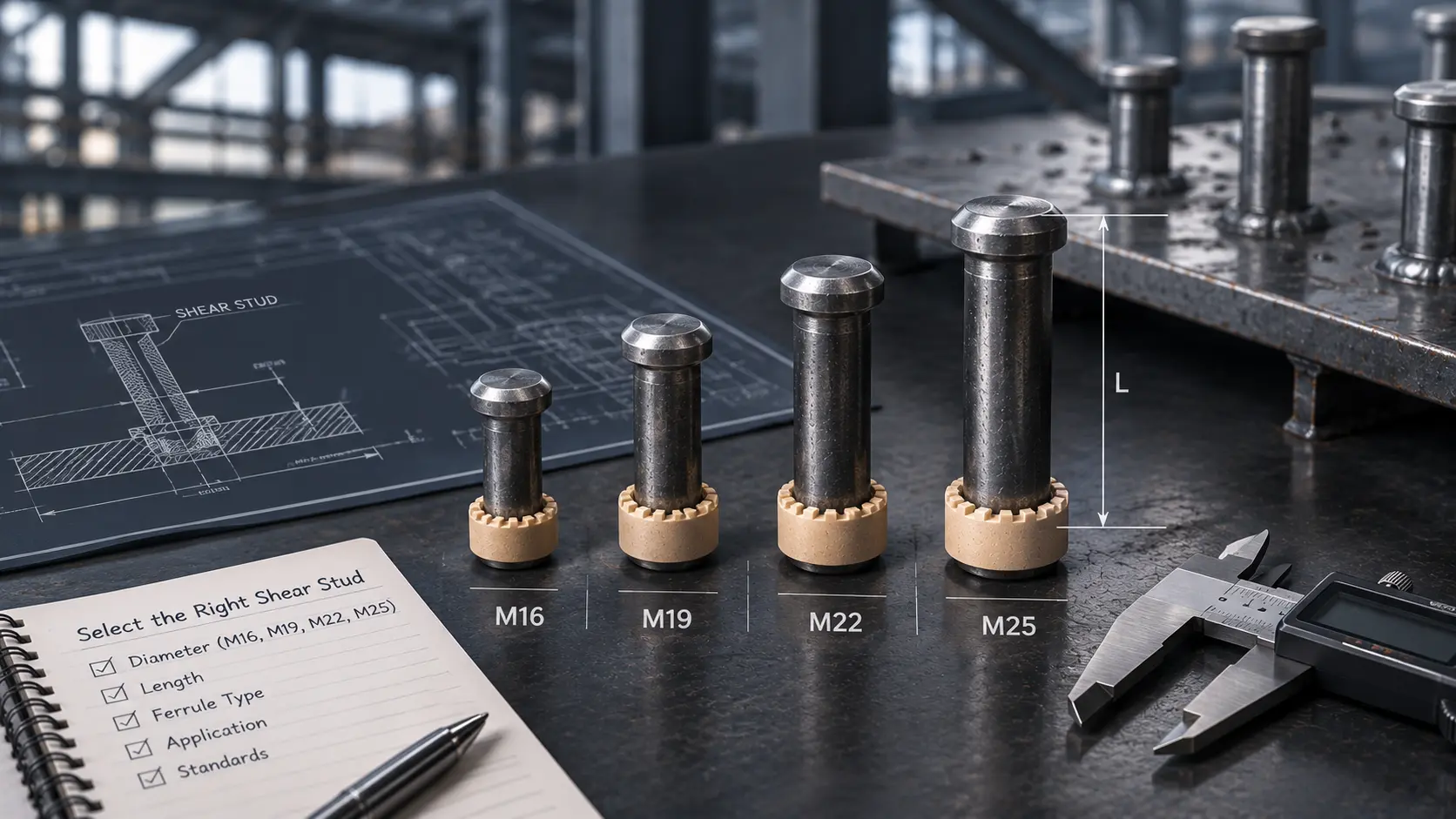
Four diameters cover the overwhelming majority of composite construction projects worldwide. Each is identified by its metric designation, which corresponds closely to a standard inch size used in AWS-based specifications.
M16 (5/8″ nominal)
Actual shank diameter approximately 15.9 mm. Used where design shear demand is modest — lighter composite beams, secondary framing members, and smaller floor decks. The lightest of the four standard sizes, and the easiest to weld with lower-capacity stud welding equipment.
M19 (3/4″ nominal)
Actual shank diameter approximately 19.05 mm. This is the most commonly specified size for standard composite floor beams in commercial and industrial buildings, and is the default reference size in several national annexes to Eurocode 4.
M22 (7/8″ nominal)
Actual shank diameter approximately 22.2 mm. Specified where shear demand is higher — deeper beams, thicker composite slabs, or projects where fewer, larger studs are preferred over a denser layout of smaller ones.
M25 (1″ nominal)
Actual shank diameter approximately 25.4 mm. The largest standard size, generally reserved for bridge girders, heavy industrial structures, and applications with high shear transfer requirements per running metre of beam.
All four sizes are typically supplied in pre-weld lengths ranging from around 65 mm to 200 mm depending on diameter, with roughly 4–6 mm of length consumed as burn-off during the arc stud welding process. Minimum tensile strength across ISO 13918 (Type SD1) and AWS D1.1 (Type B) studs is 450 N/mm² (65,000 psi), with minimum yield strength around 345–350 N/mm² and elongation of at least 15–20%, depending on the governing standard.
Side-by-Side Comparison
| Diameter | Actual Shank Size | Typical Head Diameter | Common Length Range | Typical Use Case |
|---|---|---|---|---|
| M16 | ~15.9 mm (5/8″) | ~29 mm | 65 – 130 mm | Light composite beams, secondary steelwork, smaller floor decks |
| M19 | ~19.05 mm (3/4″) | ~32 mm | 75 – 150 mm | Most common size for standard composite floor beams |
| M22 | ~22.2 mm (7/8″) | ~35 mm | 100 – 175 mm | Heavier beams, thicker slabs, higher shear demand |
| M25 | ~25.4 mm (1″) | ~39 mm | 125 – 200 mm | Bridge girders, heavy industrial structures |
Dimensions are typical/nominal figures for reference. Exact head diameter, tolerance, and length availability vary slightly between ISO 13918, AWS D1.1, and individual manufacturer catalogues — always confirm against the specific standard called up in the project drawings.
Key Factors That Decide the Right Size
Diameter is never chosen in isolation. A structural engineer works through several interacting variables before settling on a stud size for a given beam:
- Design shear force: The horizontal shear the connection must transfer per Eurocode 4, AISC, or the relevant national code — this is the primary driver, calculated from beam loading and span.
- Slab depth and deck profile: Thinner slabs or profiled steel decking with ribs running perpendicular to the beam may limit practical stud height and favour a smaller diameter with closer spacing.
- Stud spacing and edge distance: Larger-diameter studs generally require greater minimum spacing and concrete edge distance to avoid concrete cone failure — as a general principle across most design codes, edge distance requirements scale up with stud diameter.
- Concrete strength and aggregate type: Lower-strength or lightweight aggregate concrete can govern connection capacity before the stud steel itself becomes the limiting factor, sometimes pushing designers toward a larger stud rather than a denser layout.
- Welding equipment capacity: Larger diameters draw significantly higher welding current, so site welding equipment and power supply need to match the specified stud size before installation begins.
Which Size for Which Application?
As a practical starting point — always to be confirmed against the structural drawings and design calculations — the following pattern holds across most projects:
-
Light commercial floors, secondary beams, smaller decks M16 studs are usually sufficient and keep welding current and material cost down.
-
Standard composite floor beams in commercial and industrial buildings M19 is the default size most engineers reach for first, and the one most readily stocked by fabricators.
-
Deeper beams, thicker slabs, or high foot-traffic/vehicle loading M22 studs handle the additional shear demand without requiring an impractically dense layout.
-
Bridge girders and heavy industrial structures M25 is specified where shear transfer per metre of beam is high and fewer, larger connectors are structurally and economically preferable.
-
Unsure which size the project calls for? Cross-check the structural drawings and the applicable design code (Eurocode 4, AISC, or national equivalent) rather than defaulting to whatever size was used on a previous job.
Welding & Installation Considerations
Shear studs are installed by arc stud welding, and the ferrule used during welding depends on the application rather than the stud diameter alone. Direct-to-steel welding typically uses a standard ceramic ferrule (commonly referenced as type UF), while through-deck welding — where the stud is welded through profiled steel decking into the beam below — requires a ferrule designed for that purpose (commonly referenced as UFB or UFT type) to control arc shielding through the deck material.
As stud diameter increases from M16 to M25, the welding current and cycle time required also increase, so contractors should confirm their stud welding gun and power source are rated for the specified diameter before mobilising to site. It's also worth requesting a pre-production weld test on a sample of the same batch, deck thickness, and beam material to confirm weld quality before full-scale installation begins.
Common Mistakes When Selecting Stud Size
- Choosing a stud size based on what was used on a previous project rather than the current design shear calculation.
- Overlooking minimum edge distance and spacing requirements, which can govern the design even when the stud itself has adequate capacity.
- Assuming all suppliers' M19 or M22 studs share identical head dimensions — always confirm against the standard (ISO 13918 vs AWS D1.1) specified in the project.
- Ordering pre-weld length without accounting for burn-off, resulting in a shorter-than-intended embedded length after welding.
- Mixing stud batches or material certificates on a single project without maintaining traceability back to mill test certificates.
Conclusion
M16, M19, M22 and M25 shear studs each serve a distinct band of structural demand, from light secondary framing through to bridge-grade composite girders. The diameter is not a matter of preference — it follows directly from the design shear force, slab and deck configuration, and the spacing and edge distance rules in the applicable code. M19 remains the most commonly specified size for standard composite floors, but stepping up to M22 or M25 is routine wherever shear demand or slab thickness increases.
For buyers and site teams, the safest approach is always to size studs against the structural engineer's drawings and confirm the governing standard — ISO 13918, AWS D1.1, or a national equivalent — before placing an order, rather than assuming one size fits every beam on a project.
Sourcing Shear Studs for Your Project?
New Star Industries manufactures shear connector studs and high-tensile automotive and industrial fasteners under an ISO/IATF 16949:2016 and ISO 14001:2015 certified quality system, built to national and international standards with full material certification and traceability.
Contact Our Team