Class 8.8, 10.9, and 12.9 are the three most commonly used metric bolt grades in engineering and construction. Each class number tells you the bolt's tensile strength and yield strength, defined under ISO 898-1. At New Star Industries, we manufacture high tensile bolts across all three classes, and this guide explains what the markings mean, how the grades differ, and how to choose the correct one for your application.
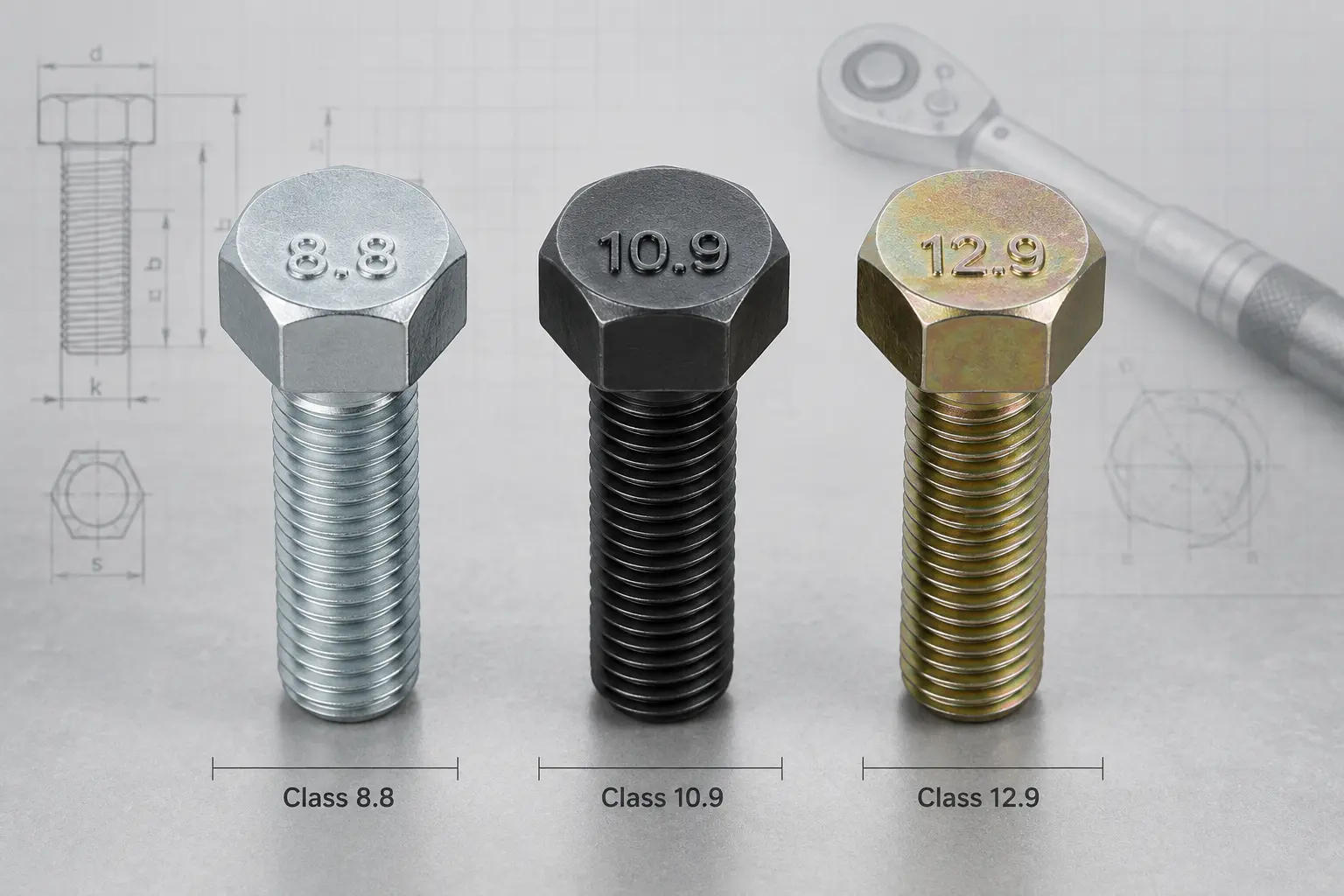
At New Star Industries, we manufacture high tensile metric bolts for automotive, infrastructure, and heavy engineering applications, and one of the most frequent questions we receive from engineers and procurement teams is which bolt class to specify for a given job. Choosing between Class 8.8, 10.9, and 12.9 is not just about picking the "strongest" option — it is about matching the bolt's strength, ductility, and behaviour under load to the actual demands of the joint. This guide breaks down each grade so you can make an informed, standards-based decision.
Metric bolt classes such as 8.8, 10.9, and 12.9 are defined by the ISO 898-1 standard and follow a simple two-part numbering system stamped directly on the bolt head.
The first number, multiplied by 100, gives the minimum tensile strength of the bolt in megapascals (MPa). For example, a Class 10.9 bolt has a minimum tensile strength of approximately 1,000 MPa. The second number, divided by 10, gives the ratio of yield strength to tensile strength. For a Class 10.9 bolt, this means the yield strength is 90% of the tensile strength, or roughly 900 MPa. Understanding this system allows you to read a bolt's strength directly from its head marking without referring to a separate lookup table.
Class 8.8 bolts have a minimum tensile strength of around 800 MPa and a yield strength of approximately 640 MPa (80% of tensile strength). They are made from medium carbon steel, quenched and tempered, and are identified by "8.8" stamped on the bolt head.
This grade offers a strong balance of strength and ductility, making it suitable for general structural connections, automotive assemblies, machinery frames, and steel structure fabrication. Class 8.8 is one of the most widely used grades in general engineering because it performs reliably under moderate to heavy static loads while remaining more forgiving of minor installation errors than higher grades.
Class 10.9 bolts have a minimum tensile strength of approximately 1,000 MPa and a yield strength of around 900 MPa (90% of tensile strength). They are manufactured from alloy steel, quenched and tempered, and marked "10.9" on the head.
This class is commonly specified for structural steel connections, flange joints, high-load automotive components, and heavy machinery where higher clamping force is needed without moving to the most brittle grade available. Class 10.9 bolts are a common choice in structural steelwork covered by international standards such as EN 14399 and are frequently used alongside matching Class 10 nuts.
Class 12.9 bolts represent the highest commonly available strength grade for standard metric fasteners, with a minimum tensile strength of approximately 1,200 MPa and a yield strength of around 1,080 MPa (90% of tensile strength). They are made from alloy steel and marked "12.9" on the head.
Because of their high strength, Class 12.9 bolts are used in demanding applications such as automotive engine and drivetrain components, precision machinery, and high-load fixtures where space and weight are limited. However, this grade is also more susceptible to hydrogen embrittlement and has lower ductility than 8.8 or 10.9, which is why it is generally not recommended for structural steel connections or applications involving shock loading, dynamic impact, or corrosive environments unless specifically engineered for it.
At New Star Industries, we manufacture high tensile hex bolts across Class 8.8, 10.9, and 12.9, engineered and tested to match the exact mechanical properties required for your application.
| Property | Class 8.8 | Class 10.9 | Class 12.9 |
|---|---|---|---|
| Minimum Tensile Strength | ~800 MPa | ~1,000 MPa | ~1,200 MPa |
| Approx. Yield Strength | ~640 MPa | ~900 MPa | ~1,080 MPa |
| Material | Medium carbon steel | Alloy steel | Alloy steel |
| Ductility | Higher | Moderate | Lower |
| Typical Use | General structural & machinery joints | Structural steelwork, flanges, heavy machinery | Automotive, precision high-load components |
Every properly manufactured metric high tensile bolt carries its class number stamped or embossed on the bolt head, along with a manufacturer's identification mark as required by ISO 898-1. Before installation, always verify the grade marking visually rather than assuming based on size or appearance, since bolts of different classes can look identical at a glance. At New Star Industries, every batch is marked and quality-checked to ensure the stamped grade matches the mechanical properties tested in our lab.
Selecting the correct class depends on the specific engineering requirement rather than defaulting to the highest available strength. Key factors to weigh include:
As a general principle, Class 8.8 is suited to general-purpose structural and mechanical joints, Class 10.9 is preferred where higher clamping force is required in structural or heavy-duty applications, and Class 12.9 is reserved for compact, high-load components — typically in automotive and precision machinery — where the design has specifically accounted for its lower ductility and embrittlement sensitivity. Always cross-check your selection against the relevant design standard or consult a structural engineer before finalising the specification.
Coating selection matters just as much as grade selection, particularly for higher classes like 10.9 and 12.9 where hydrogen embrittlement risk during electroplating is a real concern. If you are finalising a specification, our guide on Zinc Phosphate vs Zinc Electroplating vs ZAC explains how each coating process affects corrosion resistance and embrittlement risk, so you can pair the right grade with the right finish.
New Star Industries manufactures Class 8.8, 10.9, and 12.9 bolts under strict process control, from raw material selection through cold forging, heat treatment, and surface coating. Every batch undergoes tensile, hardness, and dimensional testing to ensure the stamped grade reflects the true mechanical performance of the fastener.
We support automotive OEMs, infrastructure contractors, and heavy engineering manufacturers with consistent quality, accurate documentation, and reliable supply across project volumes. If you are unsure which grade is right for your application, our technical team can help you match the correct bolt class to your load requirements and applicable standards.
Vikram Bhamra - CEO, New Star Industries
Vikram Bhamra is the CEO of New Star Industries, a third-generation manufacturing company specializing in high-performance fasteners for automotive, infrastructure, and heavy engineering applications. After graduating in Business Management from Canada in 2010, he returned to India in 2011 to lead and modernize the family enterprise. With 14+ years of hands-on experience, he has driven advancements in cold forging, zinc flake coating, and precision heat treatment. In 2024, he founded New Star AutoComp, expanding cold forged fasteners into automotive OEMs, railway bridges, PEB, and heavy engineering sectors with globally compliant fastening solutions.