Why Fastener Coating Choice Matters
A fastener's base material and strength grade only tell half the story. The coating decides how that fastener behaves once it leaves the factory floor: how long it resists rust in a coastal climate, how consistent the torque-tension relationship stays during assembly, and whether it is even safe to use at a given strength grade in the first place.
Get the coating wrong and the consequences show up later, not immediately — a bolt that looks fine on arrival can fail early through corrosion, or worse, through hydrogen-assisted cracking that was baked into the process months before the part ever saw service. This is why procurement teams and design engineers increasingly ask suppliers to specify the coating process, not just the coating colour.
What Is Zinc Phosphate Coating?
Zinc phosphate is a chemical conversion coating, not a plated metal layer. The fastener is dipped in a phosphoric acid and zinc salt solution, which reacts with the steel surface to grow a crystalline zinc phosphate layer directly out of the base metal itself, typically finished in a dark grey or black colour.
On its own, zinc phosphate offers only modest corrosion resistance. Its real value is as a porous, absorbent base layer that holds a supplementary oil, wax, or sealant, which is what actually carries most of the corrosion protection. It also improves paint adhesion and gives a slight reduction in friction, which is why it is a common pretreatment ahead of black oxide, paint, or lubricant top-coats on structural and general engineering fasteners.
Because the process does not involve an electric current, zinc phosphate carries a comparatively low hydrogen embrittlement risk, which is one reason it remains popular on higher-strength structural fasteners, including the high-tensile bolts used in preloaded steel connections, where consistent friction and reliable clamping behaviour matter as much as corrosion protection. It is a common finish on HSFG bolts and foundation-grade hardware, where a controlled, predictable friction surface is often more important than maximum salt-spray life.
What Is Zinc Electroplating?
Zinc electroplating, sometimes called electrogalvanizing, deposits a thin, uniform layer of pure zinc onto the fastener surface using an electric current in an acidic or alkaline zinc bath. The result is a bright, smooth, consistent finish that is easy to inspect visually and easy to apply in tight thread tolerances.
On its own, plain zinc offers limited protection, so electroplated fasteners are almost always passivated afterward with a chromate or trivalent chromate conversion layer — clear, yellow, black, or olive drab — which meaningfully extends the time before white rust and, eventually, red rust appear. Salt spray performance varies with plating thickness and passivation type, but electroplated and passivated fasteners typically outperform bare zinc phosphate.
The trade-off is process risk. Because zinc electroplating relies on an electric current in an acidic bath, atomic hydrogen can be absorbed into the steel during plating. On lower-strength fasteners this is rarely an issue, but on high-strength grades it becomes a genuine concern, addressed through a post-plating baking step discussed further below.
What Is ZAC (Zinc Aluminium Coating)?
ZAC, or Zinc Aluminium Coating, belongs to the family of zinc-flake coatings applied mechanically rather than electrolytically. Fasteners are dip-spin or spray coated with a suspension of fine zinc and aluminium flakes in a binder, then cured at a controlled temperature so the flakes overlap into a dense, layered barrier — closer to a lamellar shield than a plated metal film.
Because the flakes sit on the surface and are cured rather than electrodeposited, no electric current is involved at any point in the process, which removes electrolytic hydrogen pickup from the picture entirely. This is the single biggest reason ZAC has become the default coating for high-strength automotive and safety-critical fasteners, where the strength grade would otherwise make electroplating a hydrogen embrittlement concern.
ZAC systems also deliver the strongest corrosion resistance of the three coatings discussed here, often specified with a top-coat sealer or dry-film lubricant to control friction and give a repeatable, predictable torque-tension curve during assembly — a property automotive OEMs rely on heavily for joints that are torque-controlled rather than individually inspected. This is why ZAC and similar zinc-flake finishes are frequently specified on wheel bolts and other safety-critical automotive fasteners, where both corrosion resistance and torque-tension repeatability are non-negotiable.
Side-by-Side Comparison
| Aspect | Zinc Phosphate | Zinc Electroplating | ZAC (Zinc Flake) |
|---|---|---|---|
| Application Method | Chemical conversion dip, plus oil/wax top coat | Electrolytic deposition of pure zinc | Dip-spin or spray-applied zinc-aluminium flake, thermally cured |
| Typical Thickness | 3–10 microns (plus oil film) | 5–25 microns | 6–12 microns |
| Corrosion Resistance | Moderate — mostly from the carried oil film | Good, especially with chromate passivation | Very high — strongest of the three |
| Hydrogen Embrittlement Risk | Low — no electric current used | Present, especially on high-strength grades; managed by baking | Very low — no electrolytic process at all |
| Torque-Tension Consistency | Reasonable with controlled oiling | Moderate; can vary with plating thickness | Excellent when paired with a dry-film lubricant top coat |
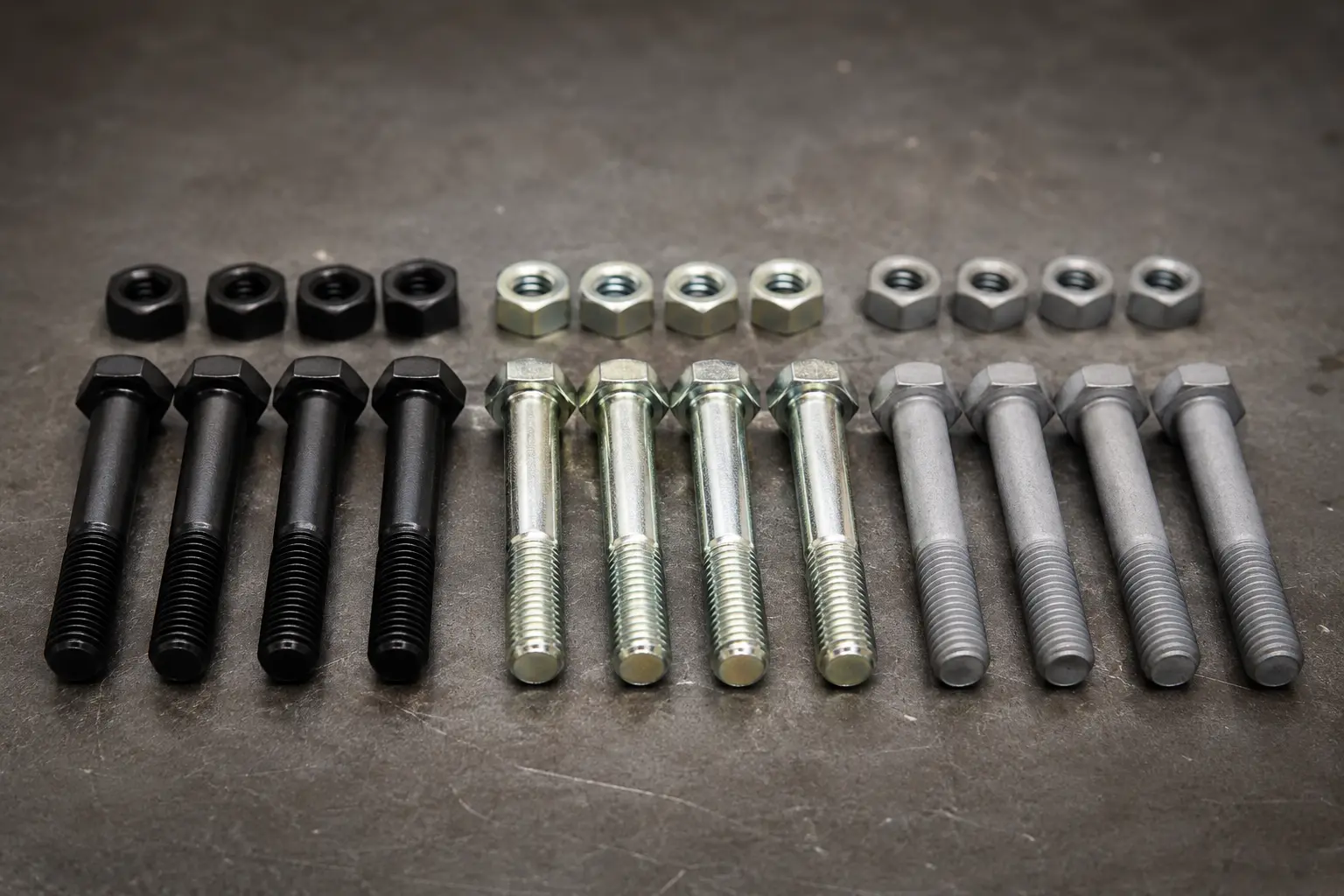
| Typical Appearance | Dark grey to black, matte | Bright silver, yellow, black, or olive depending on passivation | Matte grey to silver |
| Relative Cost | Lowest | Moderate | Highest |
| Common Use Case | General engineering, structural bolts, paint pretreatment | General automotive and industrial fasteners, lower strength grades | High-tensile automotive fasteners, safety-critical and structural applications |
Key Differences Explained
How the Coating Actually Protects the Part
Zinc phosphate protects mainly by carrying oil into a porous surface layer, which needs periodic reapplication in exposed environments. Zinc electroplating protects by sacrificial action — the zinc corrodes preferentially to the base steel — reinforced by a passivation layer. ZAC combines sacrificial zinc protection with a barrier effect from the overlapping aluminium flakes, which is why it consistently outperforms the other two in salt spray testing.
Suitability for High-Strength Fasteners
This is the most practical difference for a buyer to understand. Standards such as ISO 4042 flag electroplated coatings as a risk factor above certain strength grades, which is why many manufacturers route high-tensile fasteners toward zinc phosphate or, increasingly, ZAC rather than electroplating.
Environmental and Compliance Considerations
Older yellow and olive chromate passivation on electroplated fasteners historically relied on hexavalent chromium, now restricted under regulations such as RoHS and REACH in many export markets. Trivalent chromate passivation has largely replaced it. Zinc-flake ZAC systems are typically formulated as trivalent-chromium or chromium-free from the outset, which is one reason global automotive OEMs favour them for new programmes.
Cost Versus Performance
Zinc phosphate remains the most economical option and is perfectly adequate for indoor, low-corrosion, or short-service-life applications. Zinc electroplating sits in the middle, offering a visual finish and moderate protection at a moderate cost. ZAC costs more per fastener but reduces warranty and field-failure risk on parts where corrosion or embrittlement failure would be expensive or dangerous, which is why the higher unit cost is often justified on critical joints.
Which Coating Does Your Application Need?
The right coating depends on strength grade, environment, and how the joint is assembled — not on which finish looks the most premium. A few practical guidelines:
-
General structural or indoor fasteners with moderate exposure? Zinc phosphate with an oil or wax top coat is usually sufficient and cost-effective.
-
Standard automotive or industrial fasteners at moderate strength grades? Zinc electroplating with a trivalent chromate passivation gives a good balance of appearance, cost, and protection.
-
High-tensile automotive, chassis, or safety-critical fasteners? ZAC is generally the preferred specification, since it removes electrolytic hydrogen embrittlement risk while delivering the best corrosion resistance.
-
Coastal, marine, or heavy outdoor exposure? Favour ZAC or a thicker, well-passivated electroplated finish over plain zinc phosphate, which will need more frequent maintenance in aggressive environments.
-
Unsure which coating your application calls for? Check the customer's engineering drawing or specification first — coating callouts such as ISO 10683 (zinc flake) or ASTM B633 (electroplated zinc) resolve the question faster than guessing.
A Note on Hydrogen Embrittlement
Hydrogen embrittlement deserves its own mention because it is the single biggest safety consideration separating these three coatings. During electroplating, atomic hydrogen generated in the bath can diffuse into the steel and, under sustained tensile stress, cause delayed cracking that may not appear until the fastener is already in service.
Reputable platers manage this risk by baking electroplated high-strength fasteners at a controlled low temperature shortly after plating, which allows absorbed hydrogen to diffuse back out before it can cause damage. Zinc phosphate and ZAC largely sidestep the issue because neither process passes an electric current through the part, which is exactly why both are favoured for the highest strength grades where baking alone is not considered sufficient assurance.
Red Flags When Checking a Supplier's Coating Claims
A coating description on a datasheet is only useful if it can be verified. A few checks worth running before placing an order:
- Ask for the specific process standard referenced — such as ASTM B633, ISO 4042, or ISO 10683 — rather than a generic term like "zinc coated."
- For high-strength electroplated fasteners, request evidence of post-plating baking, including bake time and temperature records.
- Ask for salt spray test results (hours to white rust and hours to red rust) rather than accepting a general corrosion resistance claim.
- Confirm whether the passivation is hexavalent or trivalent chromate, particularly for shipments into regions with RoHS or REACH restrictions.
- For ZAC or zinc-flake coatings, confirm the top-coat and lubrication system, since friction coefficient directly affects achievable torque-tension in the final assembly.
Conclusion
Zinc phosphate, zinc electroplating, and ZAC are not simply different shades of the same protection — they are different processes with different risk profiles. Zinc phosphate is the economical, low-risk base coat for general engineering work. Zinc electroplating delivers a clean finish and solid protection for moderate-strength fasteners, provided hydrogen embrittlement is properly managed through baking. ZAC sits at the top of the performance range, built for high-tensile and safety-critical fasteners where corrosion resistance and freedom from electrolytic hydrogen risk both matter.
For an engineer or buyer specifying a coating, the right question is never "which finish looks the best" but "which process matches the strength grade and environment this fastener has to survive." Getting that match right protects the joint, protects the warranty, and ultimately protects whatever the fastener is holding together.
Sourcing Coated Fasteners for Your Application?
New Star Industries manufactures high-tensile automotive and industrial fasteners with zinc phosphate, zinc electroplating, and ZAC coating options, under an ISO/IATF 16949:2016 and ISO 14001:2015 certified quality system with full material certification and traceability.
Contact Our Team