Why Bolt Grade Markings Matter
Two bolts can look identical in size and thread pitch while being completely different parts underneath — one might be a low-strength general-purpose fastener, the other a high-tensile bolt rated for structural or automotive loads. The only visual clue separating them is the grade marking stamped or embossed on the head.
Reading that marking correctly matters because the wrong grade in a critical joint isn't a cosmetic mismatch — it's a load-capacity problem. A bolt that looks right but is one or two grades weaker than specified can fail well below the load the connection was designed to handle. This guide breaks down exactly what those markings mean, across both the metric and imperial systems.
How to Read a Metric Bolt's Grade Marking
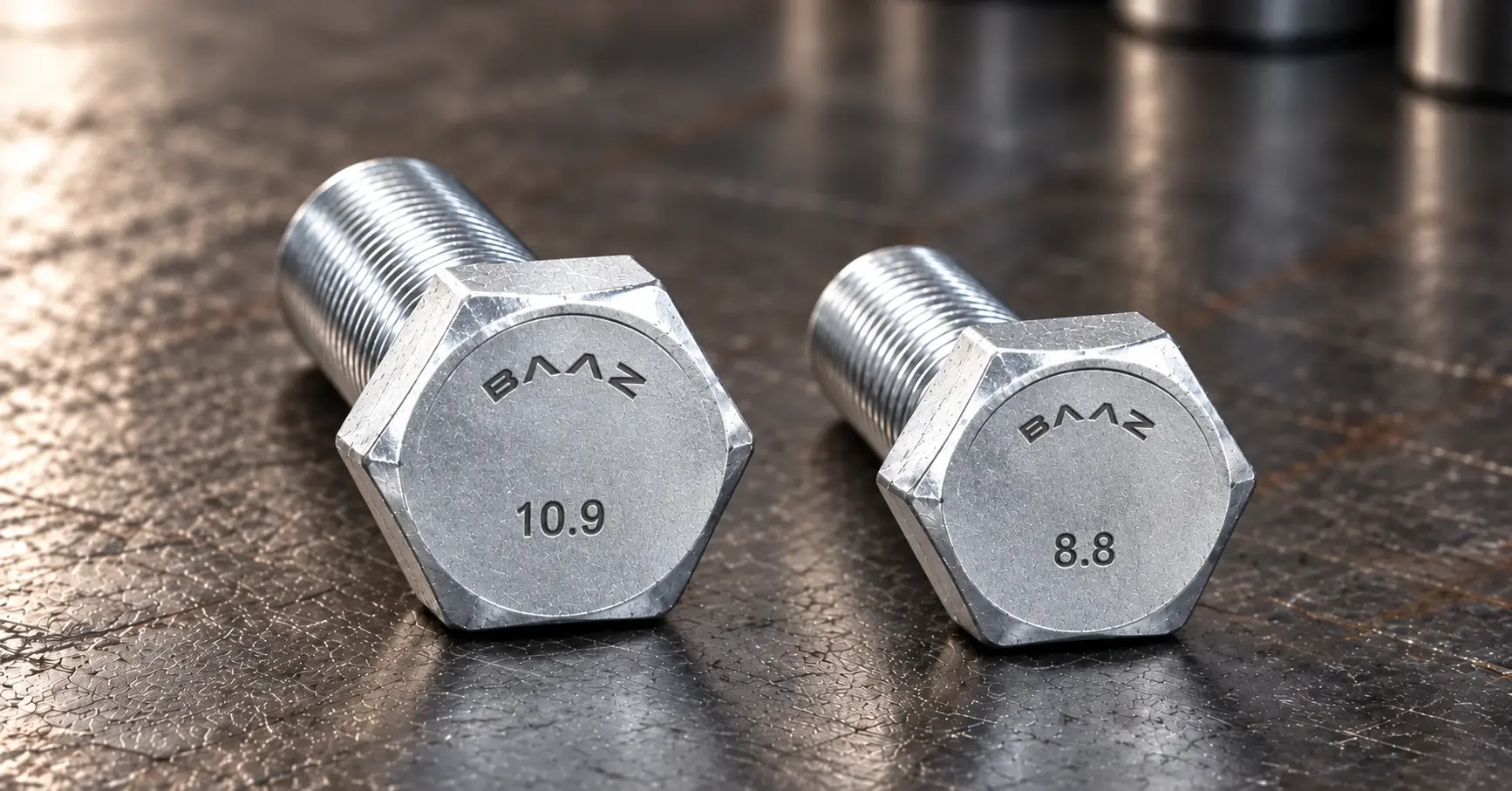
Metric bolts follow ISO 898-1, and their grade — technically called a property class — is stamped directly on the head as two numbers separated by a dot, such as 8.8, 10.9, or 12.9. Unlike the SAE system, the metric numbers aren't arbitrary labels; they directly encode the bolt's strength.
First Number — Tensile Strength
Multiply the first number by 100 to get the minimum tensile strength in MPa. A Class 8.8 bolt has a tensile strength of roughly 800 MPa; a Class 10.9 bolt, roughly 1,000–1,040 MPa.
Second Number — Yield Ratio
The second number is the yield-to-tensile ratio, expressed as a tenth. For 8.8, that's 0.8 — meaning yield strength is about 80% of tensile strength (around 640 MPa).
So for Class 10.9: tensile strength is approximately 1,040 MPa, and yield strength is approximately 90% of that, or around 940 MPa. This quick-math trick lets you estimate a bolt's strength from the marking alone, without needing to look up a chart every time.
Metric Property Class Chart (4.6 to 12.9)
| Property Class | Tensile Strength | Yield Strength | Typical Material | Typical Application |
|---|---|---|---|---|
| 4.6 | 400 MPa | 240 MPa | Low carbon steel | General purpose, non-critical |
| 4.8 | 400 MPa | 320 MPa | Low carbon steel | Light-duty fixtures |
| 5.8 | 500 MPa | 400 MPa | Carbon steel | General machinery |
| 6.8 | 600 MPa | 480 MPa | Carbon steel | Moderate-load assemblies |
| 8.8 | 800 MPa | 640 MPa | Medium carbon steel, quenched & tempered | Standard automotive & industrial bolts |
| 9.8 | 900 MPa | 720 MPa | Carbon steel, heat treated | Machinery requiring extra margin over 8.8 |
| 10.9 | 1,040 MPa | 940 MPa | Alloy steel, quenched & tempered | High-strength structural, automotive, machinery |
| 12.9 | 1,220 MPa | 1,100 MPa | Alloy steel, quenched & tempered | Critical high-load assemblies, motorsport, dies |
Values are per ISO 898-1 and represent typical minimums; actual figures can vary slightly with diameter range and manufacturer.
SAE (Imperial) Bolt Grade Markings Explained
Imperial bolts manufactured to SAE J429 use a completely different marking system — instead of numbers, they use radial lines embossed around the head. The number of lines corresponds to the grade, and critically, the line count does not include the two "reference" lines sometimes used as a starting point on older charts — count the raised radial marks directly.
| SAE Grade | Head Marking | Min. Tensile Strength | Typical Use |
|---|---|---|---|
| Grade 2 | No markings | 74,000 psi (~510 MPa) | Light-duty, non-structural fasteners |
| Grade 5 | 3 radial lines | 120,000 psi (~830 MPa) | General automotive and machinery |
| Grade 8 | 6 radial lines | 150,000 psi (~1,034 MPa) | High-stress automotive and industrial joints |
Structural bolts in the US market often follow ASTM F3125 (which absorbed the older A325 and A490 designations) rather than SAE J429, but the strength levels track closely with Grade 5 and Grade 8 respectively.
Metric vs SAE: Grade Equivalency Table
Procurement teams sourcing from both metric and imperial suppliers often need to cross-reference the two systems. These pairings are approximate — tensile values rarely line up exactly — but they're close enough for sourcing and specification purposes.
| SAE / ASTM Grade | Closest Metric Class | Approx. Tensile (MPa) | Notes |
|---|---|---|---|
| Grade 2 | 4.6 / 4.8 | ~400–510 MPa | Low-strength general purpose |
| Grade 5 / A325 | 8.8 | ~800–830 MPa | Most common structural/automotive pairing |
| Grade 8 / A490 | 10.9 | ~1,034–1,040 MPa | High-strength structural and automotive |
| — | 12.9 | ~1,220 MPa | No direct common SAE equivalent; exceeds Grade 8 |
Grade 8.8 vs 10.9 vs 12.9: Which One Do You Need?
-
General industrial, automotive, or fixture applications? Class 8.8 covers the large majority of standard bolted connections and is the most widely stocked high-tensile grade.
-
Structural steelwork, preloaded connections, or high-vibration automotive joints? Class 10.9 is the standard step-up, and is the property class used in most EN 14399 structural bolt assemblies — Baaz Fasteners manufactures EN 14399 structural bolt assemblies in grade 8.8 and 10.9 for exactly this kind of application.
-
Maximum strength with minimal weight or size — motorsport, tooling, dies? Class 12.9 offers the highest standard tensile rating, though it comes with reduced ductility and ties up sourcing options compared to 8.8/10.9.
-
Unsure which grade your drawing calls for? Check the applicable design code (Eurocode, AISC, or your project's own specification) rather than defaulting to the highest grade available — over-specifying strength can create its own problems with ductility and cost.
Matching Nut Grade to Bolt Grade
A high-grade bolt paired with a low-grade nut doesn't deliver the joint strength the bolt grade implies — the nut becomes the weak link. As a rule, nut grade should match or exceed bolt grade:
- Class 8.8 bolts → Class 8 nuts (marked "8" on the face) at minimum.
- Class 10.9 bolts → Class 10 nuts (marked "10") at minimum; do not substitute Class 8 nuts under full preload.
- Class 12.9 bolts → Class 12 nuts (marked "12"); these are specialty items, so confirm availability before specifying.
Common Mistakes When Identifying Bolt Grades
- Assuming a worn or painted-over head marking still confirms grade — if it can't be read clearly, it can't be relied on.
- Mixing metric property class bolts with SAE grade nuts (or vice versa) based on a rough strength match rather than confirming thread compatibility and actual certified values.
- Treating "higher grade is always better" as a rule — higher-grade bolts are generally less ductile, which isn't always desirable in applications where some give is expected under shock loading.
- Not requesting a mill test certificate for critical applications, and instead relying solely on the visual head marking as proof of grade.
- Forgetting that property class values can shift slightly for larger diameters under ISO 898-1 — always check the diameter-specific minimum rather than assuming one number covers the whole range.
Conclusion
Bolt grade markings are a compact but genuinely useful piece of information once you know how to read them. Metric property classes like 8.8, 10.9, and 12.9 encode tensile and yield strength directly in the number itself, while SAE grades rely on a simple radial-line count. Knowing both systems — and how they roughly cross-reference — makes it far easier to specify, inspect, and procure the right fastener for the job.
When the application is critical, treat the head marking as a first check, not the final word — pair it with a mill test certificate from a traceable manufacturer whenever the connection's failure consequence justifies the extra step.
Sourcing High-Tensile Bolts for Your Project?
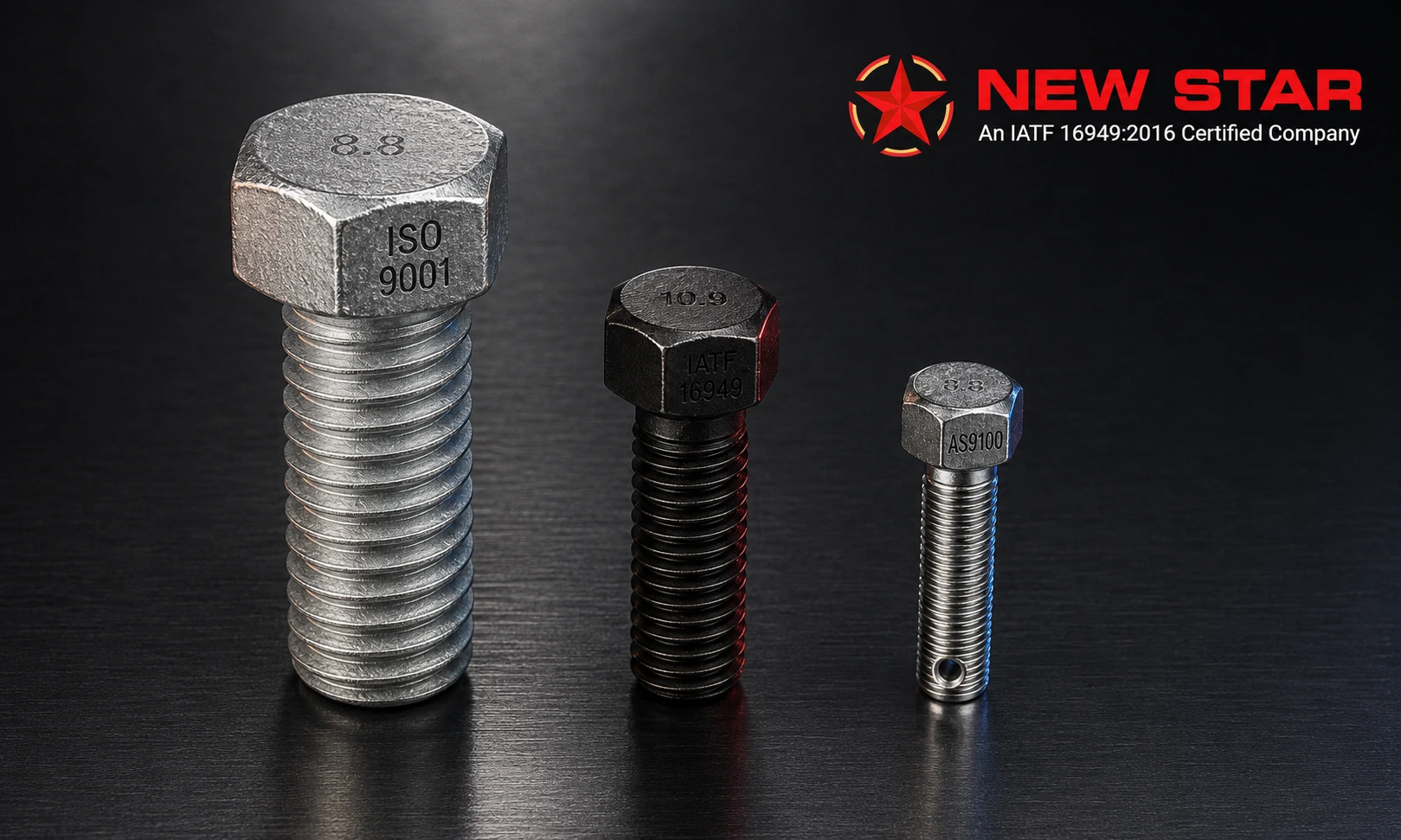
New Star Industries manufactures high-tensile automotive and industrial fasteners across grades 8.8, 10.9, and 12.9, under an ISO/IATF 16949:2016 and ISO 14001:2015 certified quality system, with full material certification and traceability.
Contact Our Team